Guntur Chillies are what is hot in this region. The pickles produced here travel far and wide, as are its weaves like Mangalagiri saree, bedsheets, and more. Once a very urban society due to the tobacco industry has declined due to the ill effects of its consumption.
Did you know that the Guntur district has many historical footprints to its credit? It may have been the first home of a man in India as Paleolithic (old stone age) implements have been found here.
The place was successively ruled by various dynasties such as the Satavahanas, Ikshavakus, Pallavas, Anandagothrins, Vishnu Kundins, Chalukyas, Cholas, Kakatiyas, Reddies, Vijayanagara and Kutub Shahis since 3rd century BCE.
Also among the famous who belonged here is the poet, scholar, and thinker Tenali Ramakrishna during Krishnadevaraya times. The famous battle of Palnadu in 1180 AD between dynasties is enshrined in legend and literature as ‘Andhra Kurukshetra’.
Some places of historical importance in the district are Amaravathi heritage town, known as the birthplace of Mahayana Buddhism, Nagarjunakonda, Kondaveedu fort, the Undavalli caves, and the archaeological museum in Guntur.
Some of the weaver clusters in Guntur district are Mangalagiri, Peteru, Sattenapalli, Isukapalli, Repalle, Cherukapalli, Illavaram and Bhattiprolu. It is said that weaving was taught in schools as a craft not so long ago.. Amaravathi once had a thriving weaving community that later migrated to Mangalagiri, Ponnur, Tenali, Sattenapalli, and other places in search of livelihood. Bhattiprolu Weavers’ Cooperative Society, though still active, has also seen a downward trend along with Macherla, Repalle, Mylavaram, and many others.
Mangalagiri

Taking us through the Mangalagiri trail is a third-generation member of a weaver’s family.. Mangalagiri is a town in Guntur district 12 km from Vijayawada. It is a pilgrimage town with the famous Panakala Narasimha Swamy temple located on top of a hill, and it is also renowned for Mangalagiri sarees!
Mangalagiri could boast 20,000 weavers belonging to the Padmasali community, whose traditional occupation is weaving. Sarees of 20/40 cotton were woven in the olden days, which were quite heavy. Such sarees were 7 yards in length and used by the farming community. The process got refined as time passed, and innovation came into play, making the fabric more user-friendly. The length and width too got standardised, and the rest is history. Mangalagiri has travelled far and wide, making it the only fabric from Andhra Pradesh to do so. As is the case with most handlooms these days, the number of weavers has come down to 2000.
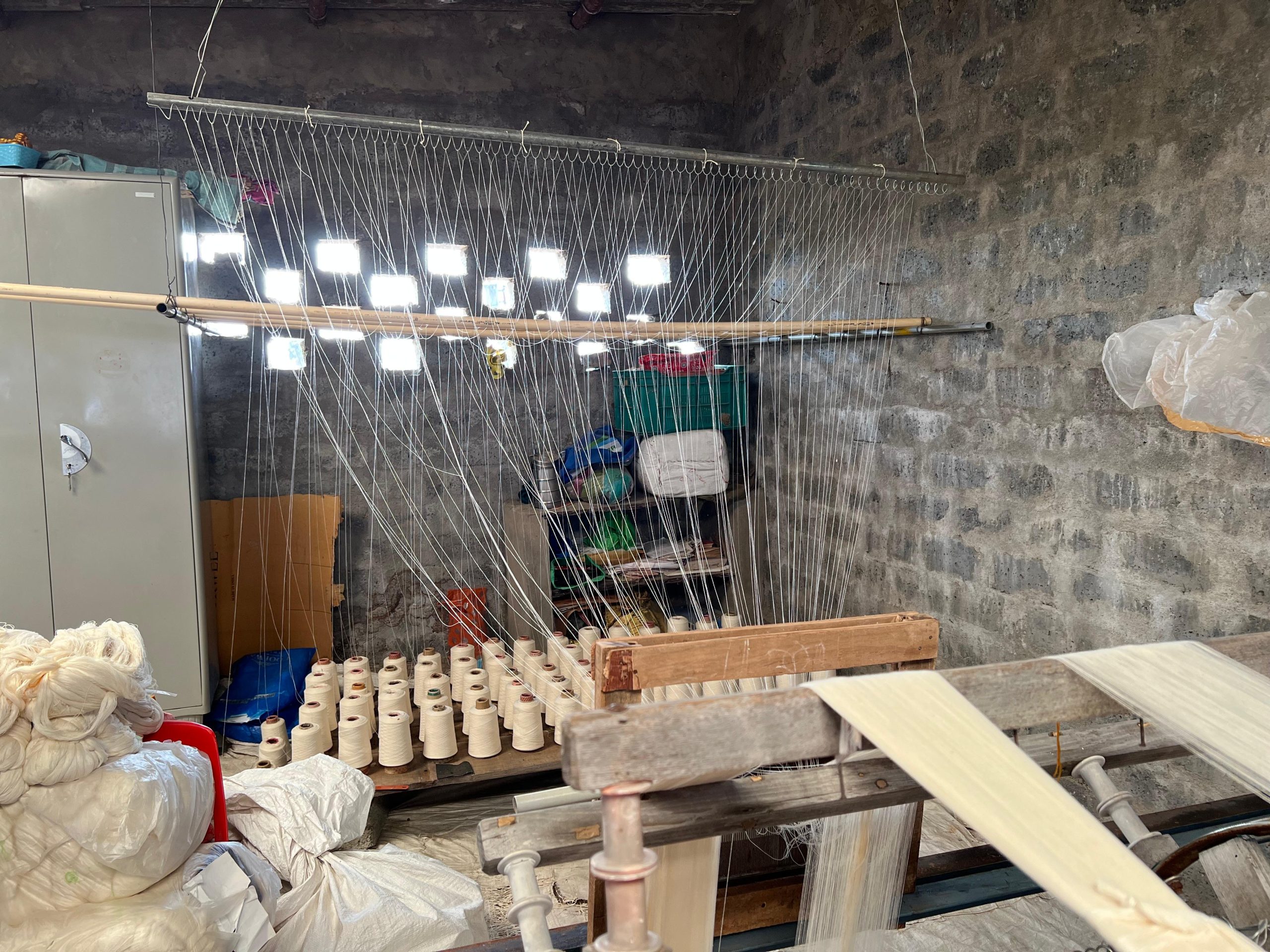
Talking about the process, she mentions making a saree is an elaborate process. It has 8 stages. Starting from spinning yarn and dyeing to weaving. Saris are woven using pit looms, where a pit is dug into the ground and the pedal of the loom is placed below. Weavers sit on the floor and use their hands and legs to operate the loom. Weaving was always a process that involved the whole family.
The innovation started as people preferred lightweight sarees. Thus weaving of 80 counts in cotton, silk and silk-cotton came into existence. From the plain cloth with ‘Nizam’ and ‘Rudraksha’ borders, they started making missed checks, silver borders and checks with border variations to catch up with modern trends. The border starts from the selvedge and does not crimple after washing. Each saree takes 3 to 4 days to complete. Weavers are paid on a unit (saree) basis. Along with sarees, yardages, salwar sets are also made, which are in great demand.
The two great icons who had revolutionised the Mangalagiri cluster with their experience are; Smt. Vijayalakshumi Prabakar, who has initiated the concept of dress material and Smt. Jagada Rajappa, who introduced new design inputs and vibrant colours in natural dyes. Mangalagiri sarees are seeing another surge in innovations. There is a fusion of Tangaliya, elaborate jamdani weaving, and pitchwai using different yarns like mulberry and kosa.
Contact details:
Rama Tulasi
9440520061
Chaitanya Lakshmi
9295010101
Sriram Tammisetty
8297794679
T.Lakshman Rao
9848046168
Peteru
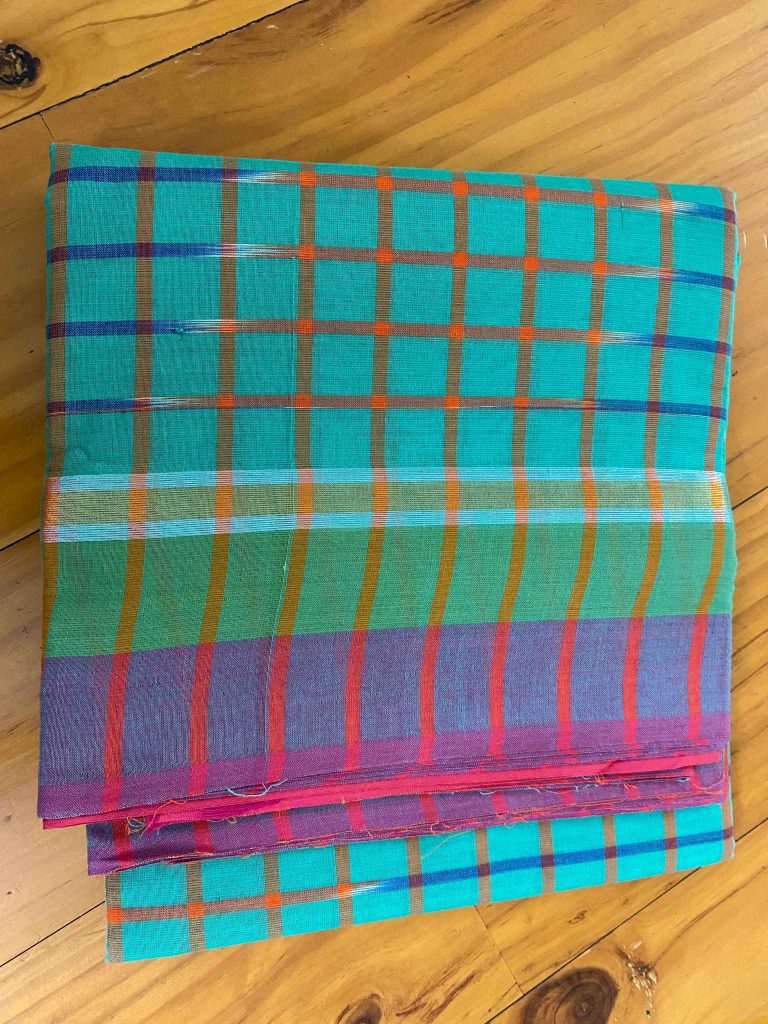
An ardent fan of handlooms, said, ‘I like handlooms very much, but I never tried to know anything about the looms or weavers. So, in the times of covid, I felt like learning more about them and started with a visit to a village in the Guntur district, Peteru, whose sarees are very popular. Striking a conversation with the artisans, they took me through how the loom is prepared. It was so interesting, like a story I would like to share’.
As told by the artisans, to weave on a handloom, they have to make a loom from natural materials like trees, gum, etc. To make a loom, people of different trades, for instance, carpenters, must come together. Carpentry work is done by the Padmasali community in Chirala and Devangalu in Pedana. The frame required for making the loom is made by another community. To cut a long story short – it’s ‘Unity in Diversity. Then comes ‘Jonna Panni’ (Telugu). Palm tree sticks and acacia gum are the critical raw materials required to make a loom frame. Jonna panni is the part of the jowar plant cut from its base to the plume (kanuka). This part is then carefully slit with a knife into fine long strands (eenalu). Each plant can be split into 4000 strands and is just as carefully done as the first. The finesse with which this work is done is praiseworthy. These strands are used to weave a rope on both ends of the frame. Acacia gum is applied to the string to give it stiffness and durability. The frame, when ready, can be used for 3940 strands of warp.
There were once 600 working looms. They acquire yarn from Mangalagiri, Pedana and Puttapaka. Most processes are outsourced, as is the case in most places. Very few clusters have all facilities available in one place. Their products are so popular that people almost wait for the product to come out of the loom!! And sometimes, they are almost out of stock. The pandemic did take a toll on their sales.
Contact details:
Siva
9492902309
9010089423
Rajolu
Rajolu supplies materials to Dastkar Andhra and also participates in craft exhibitions. They have their own ancillary facilities like dyeing, sizing and warping. This Society is well maintained with good planning and gives support to others. 60/40, 80/60 count cotton shirting and dress materials are made here.
Contact details
Subba Rao
9849458464
Panidam-Sattenapalli
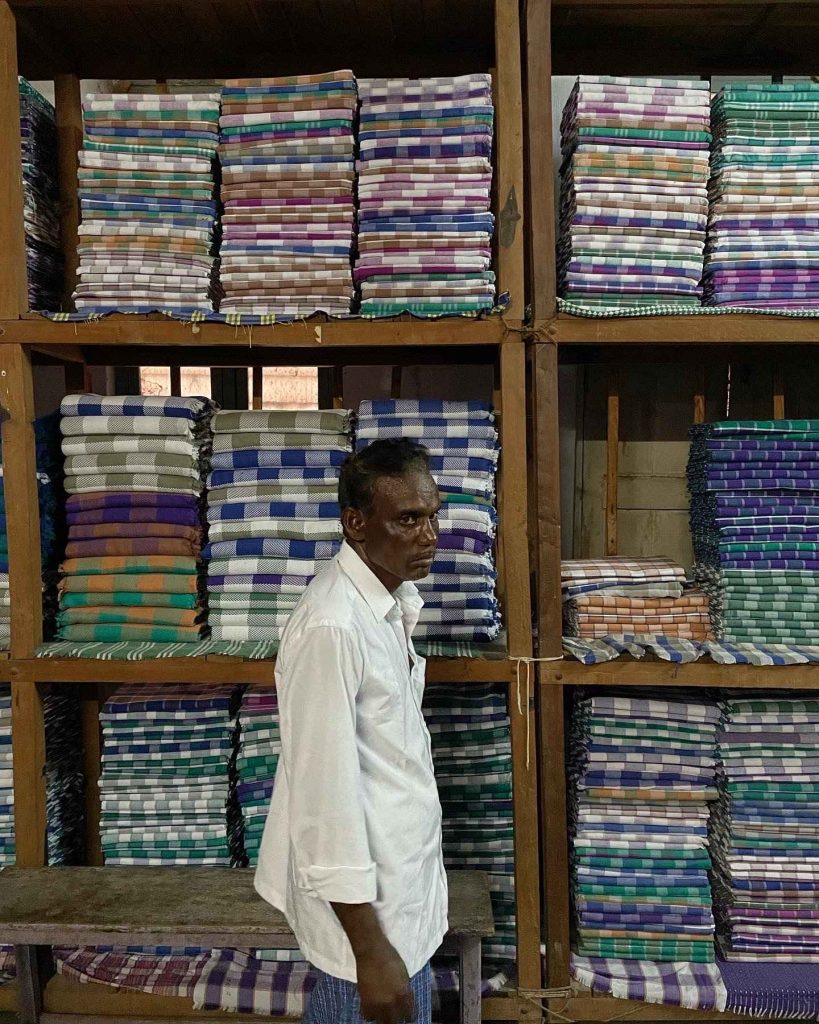

Panidem society in Sattenapalli is the second oldest Society in Andhra Pradesh after Eminganur. It celebrates 75 years of existence in this ever-changing and challenging handloom industry. Starting during the pre-independence times and creating a weavers colony where none existed is not an easy task.
Steeped in history and keeping the old charm intact is this society and its caretaker president Sri Durga Rao who took us through the historical and nostalgic journey the society has seen. A CCAP member visited the Panidem Society in February 2022. He spent his time looking around the society exploring the types of looms and different product categories, and processes involved in pre-loom and weaving processes. According to him, they are currently operating in 40 frame looms and have jacquard, and dobby looms with them but couldn’t create work to run those looms.
The Panidem society has a vast space to accommodate 300+ looms and can give work to 500+ weavers, dyers, and other artisans involved in the preliminary process. Due to a lack of artisans and next-generation weavers, they cannot run at full scale. The society can accommodate all the processes involved in weaving in-house in one place. They have space and equipment for warp, weft winding, dyeing, and storage/godown.
There is a perfect scope for us (CCAP) and other NGOs to work with them and develop a new range of products, and the Society is also up for new challenges and can cooperate in product development. They have good skills and are eager to learn new techniques, where the Weavers service center plays a big role. They have a good range of products like bedsheets, mosquito nets, curtains, napkins towels etc. Bedsheets and mosquito nets are unique selling products for which they have a good market.
Contact details
Durga Rao
9290725767
Srinivas Rao
9885609021
Isukapalli


Isukapalli is a scenic town with banana and other plantations on one side and the river Krishna on the other. We were pleasantly surprised by the welcoming, cool, clean verandah and the well-stocked shop behind. We visited the Isukapalli Weavers Cooperative Society in December 2019.
Unlike other societies, it has its own spindles and looms for the weavers. About 800 weavers live in this small village, weaving hand towels, napkins, bath towels, 60″ bedsheets and yardage. One could consider discontinuing paper towels and stocking up on hand towels and napkins, which are excellent alternatives.
Sobhan Babu is Manager who drives the society along with the veteran Koutarapu Venkata Subbarao, 94 years old, as President.
Contact details
Shoban Babu
08648 222885
Nidubrolu

Nidubrolu in Ponnur mandal of Guntur district is one of the several weavers societies of this district and others being Kothareddypalem, Cherukapalli, Rajolu, Peteru, Sattenapalli, Isukapalli and more.
Most of the places have societies except Peteru. Kothareddypalem has two societies and some individual weavers. This society was trained in ikkat by the central government with their contacts in Puttapaka. They produce Guntur cotton sarees and yardage.
Nidubrolu society makes bed sheets, towels, and handkerchiefs. A renowned freedom fighter, Parliamentarian and MLA, Sri Pragada Kotaiah Garu, a native of Nidubrolu, studied all aspects of weaving, provided land for the society and encouraged them. The SPK Memorial Institute of Handloom Technology, started in 1992 in Venkatagiri, is one of the eight institutes in the country, which speaks a lot about his contribution to this craft.
Nidubrolu society has its own dyeing unit, including all others. It also has a vast 8 pedal loom operated by a single person. However, the loom is in disuse due to a lack of interest in the present generation and low wages. A single bed sheet can be woven, and it has a twill finish.
A proposal to weave sarees did not materialise. While the male members have shifted to better-paying jobs, the women rake up a living by doing ancillary jobs for weavers. The bed sheets were known as Khaddar which was very common in the olden days and they felt cool in summer and warm in winter!
Contact details
P. Balaj
+91 9440241026